
EAST AFRICA RESEARCH CHAIR ON FORCED DISPLACEMENT
Introduction of the Research Chair on Forced Displacement
The University of Dar Es Salaam Research Chair on Forced Displacement (UDSM-RCFD) was introduced in July 2022 and began its operation in December 2022. The Chair was introduced under a five-year project that is funded by the International Development Research Centre of Canada (IDRC) titled: “Strengthening knowledge, evidence use and leadership in the global south on forced displacement: with a focus East Africa.” Hosted in the Department of Geography, RCFD has 32 members who are working on issues of displacement or related from different disciplines including Geography, Law, Development Studies, Sociology, Political Sciences, Business, Food, Science, and Agriculture across East Africa.
Activities
- Research and capacity building in research
- Outreach
- Seminars, symposiums, and conferences
- National and regional policy dialogues
- Introduce a Master’s program in forced displacement
Research Approach
The research done under RCFD takes a demand driven, action oriented gender sensitive and gender transformative research which will result in empowering and informing policy. It uses what we call a study up approach instead of a top down where researchers determine the issues to focus on. It
is qualitative by nature and uses decolonizing approaches which are more conversation participatory in nature.
Main Objective
The main objective of the Research Chair on Forced Displacement is “To support timely,
innovative research in forced displacement settings in East Africa, by bringing local knowledge
and practice to influence policy processes at national, regional, and global levels through
promoting policy dialogues and public debates on forced displacement that amplify Southern
voices of the forcibly displaced communities.”
Specific Objectives
01. Generate context-informed and multidisciplinary knowledge on forced displacement that is led by researchers in the region and guided by the priorities of displaced populations, with a focus on livelihood security, social and legal protection for conflict-displaced refugees and those internally displaced by climate, conservation, or large-scale development events.
02. Inform policy-making processes on forced displacement at national and regional levels through policy outreach and strategic collaboration with civil society organizations.
03. Enhance policy debates on forced displacement globally and increase the intellectual presence of the region in these global debates, through concerted activities at the University of Dar es Salaam (UDSM) and engagement with IDRC funded chairs in other regions.
04. Institutionalize the study of displacement at UDSM through increased cross-faculty collaboration, mentoring of early career scholars, and development of a Masters-level curriculum in the Department of Geography on forced displacement.
Who are We?
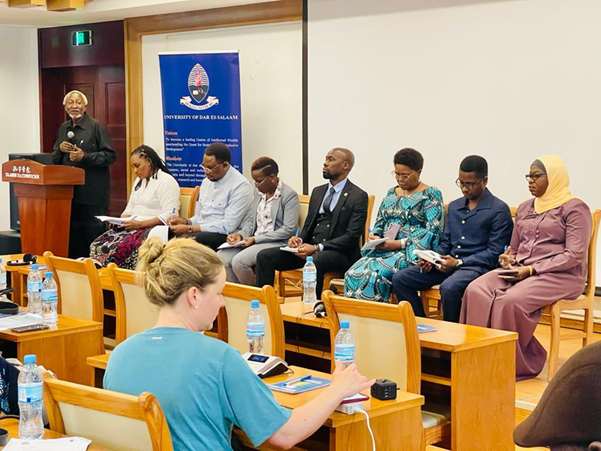
Regional and National Policy Dialogues
The Research Chair on Forced Displacement is a multidisciplinary initiative housed in the Department of Geography, College of Social Sciences, at the University of Dar es Salaam. The Chair comprises experts from various fields. It operates across East Africa and engages in research, seminars, outreach programs, policy dialogues, and research support related to forced displacement. With over 35 members, the Chair continues to recruit more researchers through various projects. Its work primarily covers Tanzania, Kenya, Uganda, Rwanda, and Burundi, with extended collaboration across East Africa through a network of scholars studying displacement.
Established in July 2022, the Chair is funded for five years and is among 12 Chairs globally supported by the IDRC. Its primary research focus is on amplifying the voices of displaced communities and promoting perspectives from global South scholars on forced displacement. The Chair aims to conduct demand driven action oriented, bottom up research which amplifies issues of the displaced and ideas of global south scholars. The research aims at comparing policies and practices on displaced communities in East Africa and disseminate findings at the national, regional and global levels.